Back to guidesFeeding Your Baby — gentle baby care guidance for new parents

Feeding Your Baby

Breastfeeding, formula, hunger cues, and starting solids with confidence.

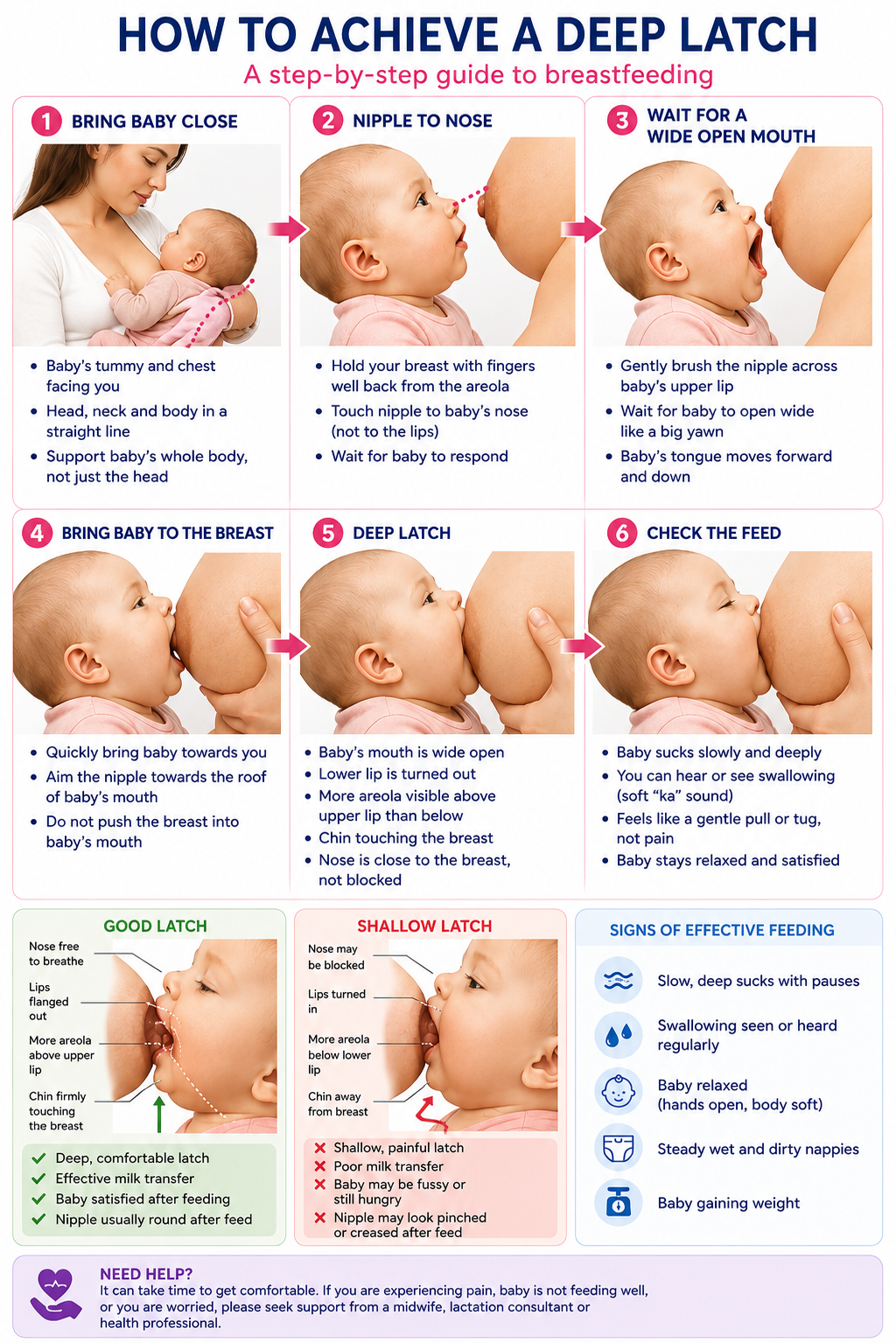
Step-by-step infographic showing how to achieve a deep latch: bring baby close, nipple to nose, wait for a wide open mouth, bring baby to the breast, check for a deep latch, and signs of effective feeding
How to achieve a deep latch — a step-by-step visual guide. If feeding hurts or baby isn't feeding well, speak to your midwife, lactation consultant, or health visitor.

1. Breastfeeding basics

  • Feed on demand in the early weeks — most newborns want 8–12 feeds per 24 hours.
  • A good latch is key: baby's mouth wide, lower lip flanged, chin touching the breast.
  • Let baby feed from one breast until soft, then offer the other.
  • Stay hydrated and eat regular meals; your body needs energy to make milk.

2. Before you latch

  • Get comfortable and support your back, shoulders and arms. Bring your baby to the breast rather than leaning forward.
  • Keep your baby close, with their head, neck and body in a straight line and their tummy facing your body.
  • Aim your baby's nose toward your nipple. This encourages them to open their mouth wide and take in a good amount of breast.

3. How to achieve a deep latch

  • Tickle or brush your nipple across your baby's upper lip and wait for a wide-open mouth.
  • Bring baby quickly and gently toward the breast, aiming the nipple toward the roof of the mouth.
  • Baby's chin should be close to the breast, with the nose free or lightly touching.
  • You should see more of the areola above the baby's upper lip than below it, although this can vary.
  • The baby's lips should be flanged outward and their cheeks should look rounded rather than dimpled.
  • A comfortable latch should feel like a strong tugging or pulling sensation rather than sharp or pinching pain.

4. Breastfeeding positions

  • There is no single 'correct' position — choose what is comfortable for you and keeps baby close, supported and aligned.
  • Cradle hold: baby lies across your front with their head supported in the crook of your arm — comfortable once you're both confident.
  • Cross-cradle hold: use the arm opposite the breast to support baby's neck and shoulders, giving more control while learning to latch.
  • Football / rugby hold: baby is tucked alongside your body under the arm on the same side — useful after some births or to keep pressure off the abdomen.
  • Side-lying: you and baby lie facing each other. For sleep, always follow safe-sleep guidance and return baby to their own safe sleep space after the feed.

5. Signs feeding is going well

  • You can hear or see regular swallowing once your milk is flowing.
  • Baby's jaw moves deeply and rhythmically rather than only making small sucking movements.
  • Baby appears relaxed during and after the feed and releases the breast naturally when finished.
  • Wet and dirty nappies and weight gain are appropriate for your baby's age and individual circumstances.

6. If the latch hurts

  • If feeding is painful, your nipple looks pinched or misshapen after a feed, or baby repeatedly slips off, gently break the suction with a clean finger and try again.
  • Ask for support if baby consistently struggles to latch, feeds are very painful, you're worried about milk supply, or there aren't enough wet nappies.
  • Persistent pain or concerns about milk transfer or weight gain should be discussed with a midwife, health visitor, lactation consultant or doctor — early support makes a big difference.

7. Formula feeding

  • Follow the powder-to-water ratio on the tin exactly — never dilute or concentrate formula.
  • Use freshly boiled water that has cooled for no more than 30 minutes for babies under 3 months.
  • Discard any formula left in the bottle after one hour at room temperature.
  • Sterilise bottles and teats until your baby is at least 12 months old.

8. Hunger & fullness cues

  • Early hunger: stirring, opening mouth, rooting, bringing hands to mouth.
  • Late hunger: crying, agitated body movements. Try to feed before this stage.
  • Fullness signs: slowing down, turning away, sealing lips, pushing the bottle away.

9. Starting solids

  • Most babies are ready around 6 months when they can sit upright and show interest in food.
  • Start with single-ingredient purees or soft finger foods like steamed vegetables.
  • Introduce common allergens (peanut, egg, dairy, wheat) one at a time in tiny amounts.
  • Continue milk feeds alongside solids; food is complementary until 12 months.

When in doubt, ask a professional

This guide is for general information only. If you're worried about your baby's health or feeding, speak with your GP, health visitor, or paediatrician.